
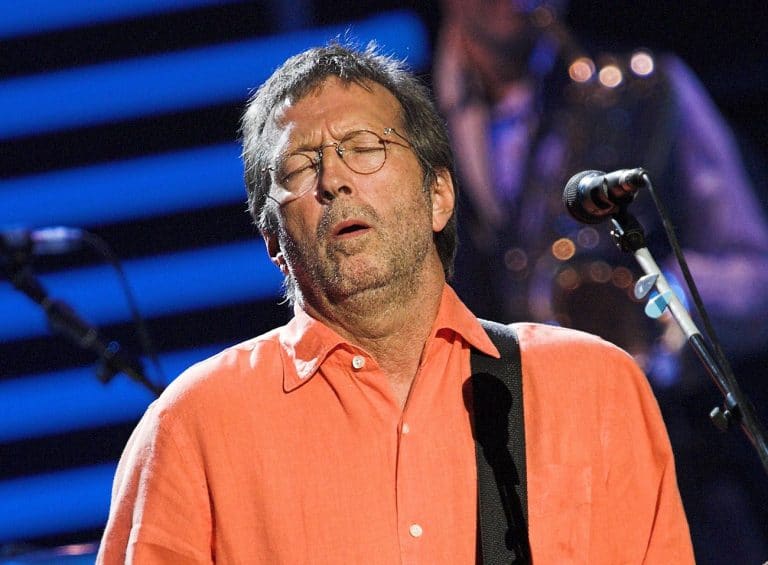
Eric Clapton, the legendary guitarist revered for his unparalleled contributions to rock music, recently launched a scathing critique of the Rock and Roll Hall of Fame, branding it as a “frat boys’ club.” Despite being the only artist to have been inducted three times into this prestigious institution, Clapton’s disenchantment with the Hall underscores a deeper disillusionment with what he perceives as its failure to represent the true spirit of rock music.
Clapton’s journey with the Rock and Roll Hall of Fame began with his induction as a member of the Yardbirds in 1992, followed by another accolade with Cream in 1993, and finally, an honor for his solo career in 2000. However, his initial excitement has been gradually overshadowed by skepticism. In a candid interview with The Real Music Observer, Clapton expressed his frustration, stating, “I think it’s a club of frat boys, but they have managed to lure me in…” His initial involvement was swayed by the presence of influential figures like Ahmet Ertegun, cofounder of the Rock Hall, who Clapton admired for his dedication to artists who were often overlooked. Yet, as the years passed, Clapton’s trust in the institution waned, especially due to the influence of figures like Jann Wenner, the founder of Rolling Stone magazine, whose involvement made Clapton wary from the start.
Central to Clapton’s criticism is the Hall’s selective recognition of artists, which he believes neglects significant contributors to rock music. He cites the absence of guitarist J.J. Cale from the Hall as a glaring oversight, arguing that Cale’s omission demonstrates the institution’s failure to acknowledge the full spectrum of rock music. “The fact that someone like J.J. has never been suggested proves what this institution really is, or what it isn’t,” Clapton contends. Similarly, he points to Paul Rodgers, former frontman of Free and Bad Company, as another example of an artist unjustly excluded. Clapton describes Rodgers as a “rebel” and asserts, “It’s not a place for rebels. It’s a bastion of the establishment.” This sentiment highlights Clapton’s belief that the Hall prioritizes commercial success and mainstream appeal over genuine influence and artistry.
Despite his criticisms, Clapton fondly recalls his reunion with Cream during the 1993 induction ceremony, cherishing the opportunity to reconnect with his former bandmates. Yet, even these personal memories do not overshadow his conviction that the Rock and Roll Hall of Fame remains an institution that, in his view, fails to truly honor the rebellious spirit of rock music. As Clapton’s words reverberate through the music world, they serve as a poignant reminder of the ongoing debate over how best to celebrate and preserve the legacy of rock and roll.


The conversation 0
Different voices. A shared love of heavy music.
Be the first to share your thoughts.
What stands out to you? Start the conversation.
Join the conversation
Keep it thoughtful and respectful. Comments are reviewed before appearing.