
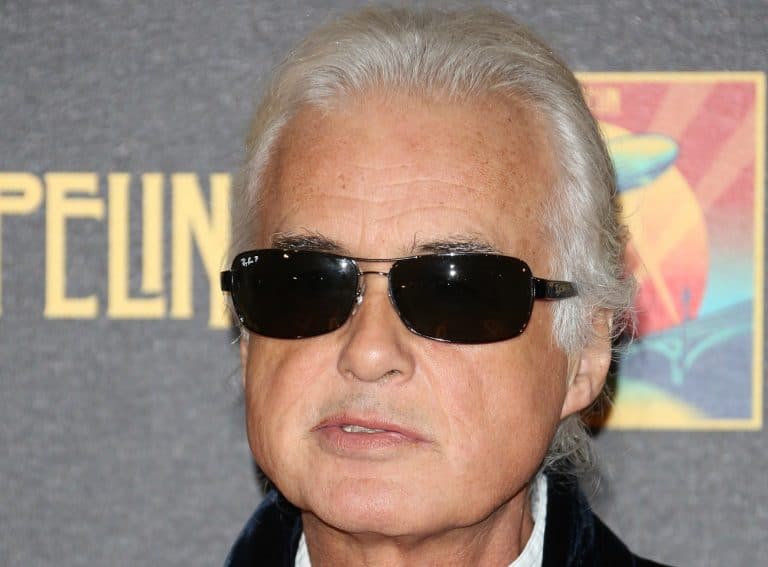
In a stirring statement that has captured the attention of the artistic community, legendary Led Zeppelin guitarist Jimmy Page has voiced sharp criticism of the British government’s proposed Data (Use and Access) Bill. This legislation, which recently concluded its public consultation phase, includes controversial measures allowing artificial intelligence to utilize existing musical works for learning purposes unless artists explicitly opt out. Page argues that such a system not only undermines the authenticity of artistic creation but also exploits creators without offering fair compensation.
At the age of 81, Page remains a formidable advocate for artistic integrity. He warns that the encroachment of AI into the realm of music and the arts poses a significant threat to the essence of human creativity. “Today, as artificial intelligence seeks to imitate and monetize creativity, we stand at a crossroads,” he asserts. Page describes AI-generated art as lacking the visceral essence derived from lived experiences, reducing it to “hollow echoes” devoid of the struggles, triumphs, and soul that are the hallmarks of true artistic creation. Furthermore, he highlights the ethical implications of AI practices, which often involve data extraction from the vast repertoire of human creativity without consent, attribution, or compensation. To Page, this is not innovation but exploitation.
Page’s critique extends to the opt-out system proposed by the bill, which he dismisses as a “sham.” He argues that it is technically unfeasible for artists to consistently safeguard their rights in advance. “This consultation does not propose regulation but rather grants AI a free pass to exploit creativity without consequence,” he contends. In a call to action, Page urges both the public and lawmakers to reject the bill and advocate for policies that respect creators’ rights. “We must defend policies that protect artists, ensuring their work isn’t absorbed into the ‘void of machine learning’ without proper consideration,” he insists. Page passionately concludes that the choice is ours: to either allow machines to take the stage or fight for the irreplaceable magic of human art.
As the debate over AI’s role in artistic creation intensifies, Page’s words serve as a powerful reminder of what’s at stake—the preservation of the human touch in art, with all its imperfections, emotions, and stories.


The conversation 0
Different voices. A shared love of heavy music.
Be the first to share your thoughts.
What stands out to you? Start the conversation.
Join the conversation
Keep it thoughtful and respectful. Comments are reviewed before appearing.